Jamie's Reserves Diary - March 9th to 13th

Jamie's Reserves Diary - March 9th to 13th

Photo by Jamie Proud

A weekly roundup of being a Bedfordshire Reserves Officer, with volunteer tasks and why we do what we do.

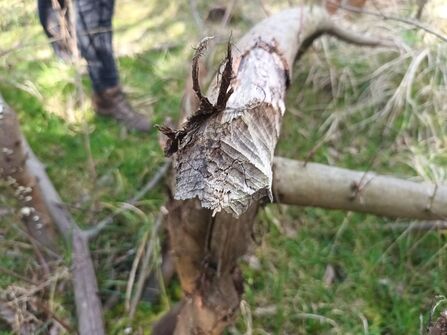
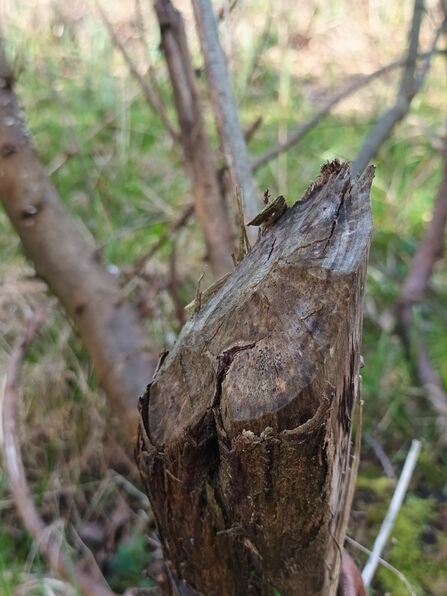
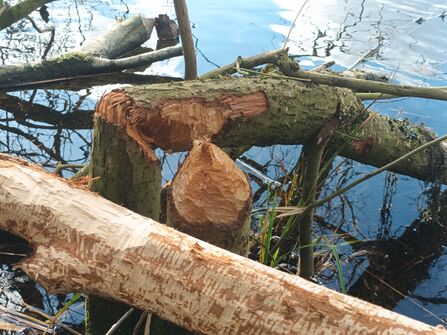
Hi all!  I was off on Monday, so nothing to report for then, but on Tuesday the Trust had its annual All Staff Day.  This is an opportunity for all the Trust staff to get together and get updates on departments they may not have much contact with, such as how membership recruitment is doing, how education events are going etc, along with some talks on relevant subjects like housing and development, climate change, etc. As it was my first All Staff Day, I found it very interesting.  They also planned out a number of activities for staff to do, such as a bird spotting competition, or spend time using microscopes and learning about microscopic water life.  One option is so popular that it’s now only open to staff who haven’t done it before, and that was the chance to have a guided tour inside the Beaver enclosure at the Nene Wetlands, close to Rushden Lakes, which I obviously chose to do!  It was fascinating seeing what the beavers had been up to. 

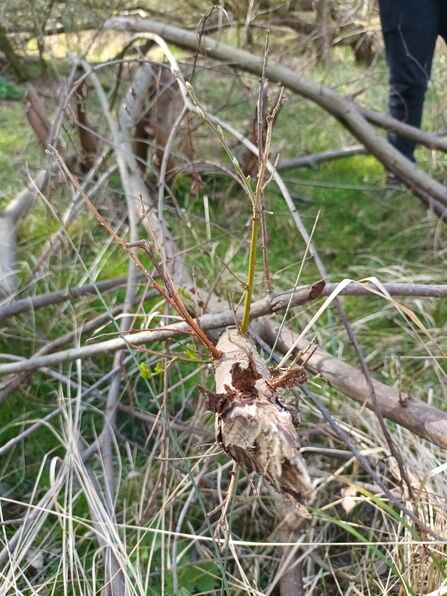
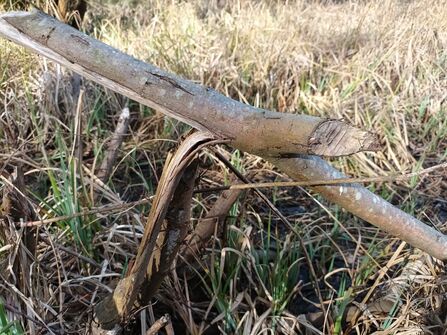
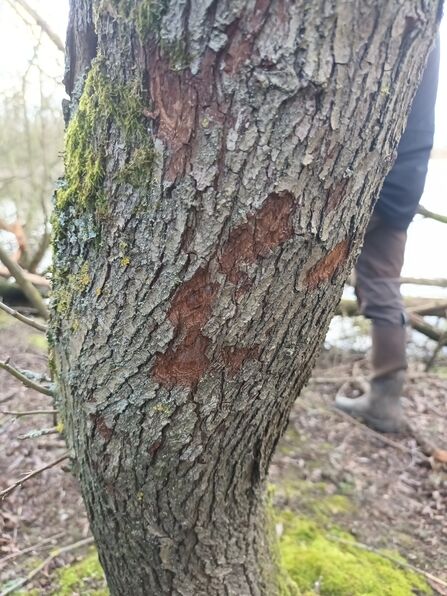
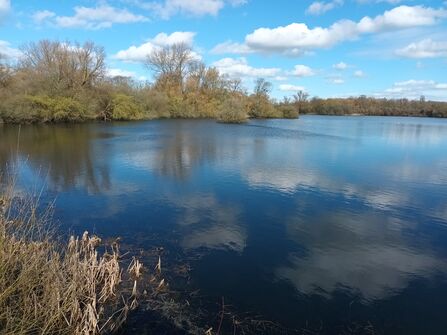
The enclosure is around one of the lakes, so the beavers cannot get to the river, or disappear up or down stream (there are public paths along some of the enclosure where you have a chance to see the beavers yourselves).  The lake is large and deep enough that the beavers have shown no interest in leaving.  They only build dams in flowing water, to create deep water, and there is no flowing water within the enclosure, and the water is deep, so they haven’t needed to build any dams.  They are ecosystem engineers and modify their environment to be more suitable for themselves, and also do a form of farming.  They mainly feed on tree bark and to get as much food from a tree as possible, they gnaw through the base and drop the tree (as they are famous for). If the limb is thin enough, they remove the limb and strip bark from the larger bits and then eat all the twigs on the ends.  If the limb or trunk is big, they leave it attached to the stump so that it will continue to grow, but now the top of it is on the ground where they can reach it. They basically coppice and lay the trees so they regrow with new, thin branches which becomes food for them the following year or two.  They have preferences for food as well.  They’ll eat bark from willows and poplars, but don’t like hawthorn, for example. They also like the roots of some of the reeds, so they pull up and eat the roots, creating channels/canals through the reed beds, which are used by water birds and other animals too.  They are mostly nocturnal and spend the day inside their lodges, which may be inside a dam, a log island they build in the water, or a burrow that is screened with a branch pile.  Due to flooding, they have made a number of burrow style lodges around the site.  The driest one is quite a long way from the water, and they actually dug a ditch from the lake to the lodge, so they can swim to the lake!  They live as a family group and the founding matriarch and patriarch breed together exclusively, and no other beavers in the group will breed, so there is no risk of inbreeding, and population growth in the enclosure will be quite slow.  As long as there is enough habitat and food for them, the young will not try to leave and start their own groups.  If they start infighting, then that will be a sign that there may be too many for the current enclosure.  Our guide, Reserve Officer (R.O.) Dan from the Northamptonshire arm of BCN Wildlife Trust, was very, very informative, but even he admitted that they are all still learning as there have not been beavers wild in the UK long enough for anyone to really know everything about them here. The Wildlife Trust is constantly taking advice and learning from beaver experts, such as the Beaver Trust, to ensure the beavers have what they need, and we’re doing everything required for successful beaver reintroduction. 

As the All Staff Day was on a Tuesday, which is a task day, Senior R.O. Andy ran a scrub and hay task at Old Warden Tunnel.  Thanks Andy, and thanks to all the volunteers!
On Wednesday, Senior R.O. Andy ran a volunteer task at Totternhoe Quarry, but I had another medical to attend.  The Trust is very caring of its staff, and we all get medicals so they can see whether our work is negatively affecting our health and if practices need changing to ensure the staff stay safe and healthy.  As I’m new, they don’t have any base-line figures for me and some pre-existing niggles needed investigating to ensure they weren’t, or wouldn’t become, health issues.  In the end the niggles I have aren’t serious, but I should probably do a bit less brushcutting for a few weeks as I have a minor wrist issue that only pops up with brushcutters. The rest of the day was spent catching up on paperwork.  

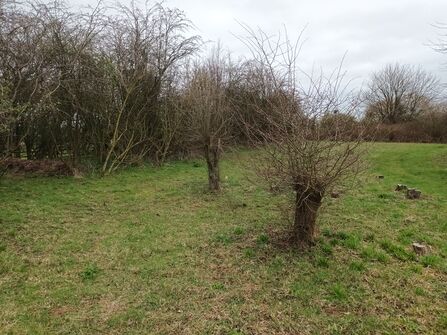
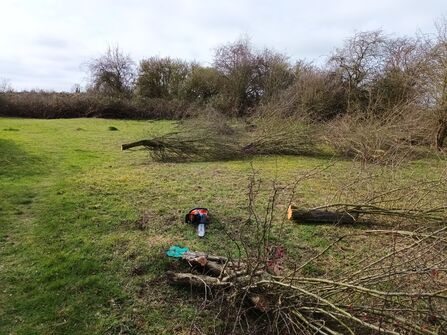
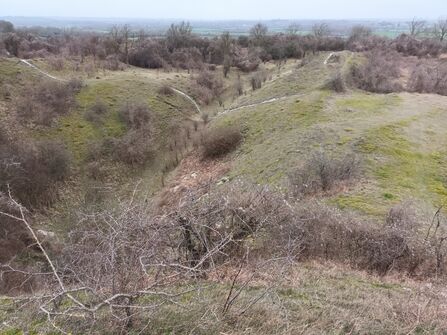
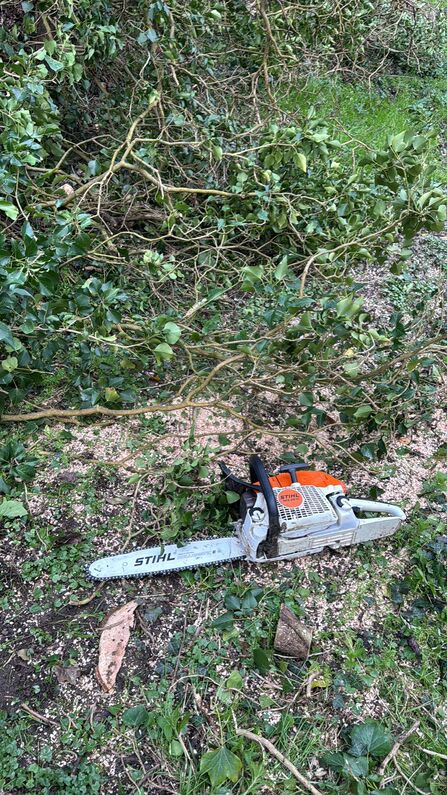
On Thursday, R.O. Matt ran a scrub task at Blow’s Downs.  Thanks to the vols for their vital efforts maintaining the chalk grassland! Meanwhile, I took the opportunity to work with, and learn from, our highly experienced and knowledgeable S.R.O. Andy. Suncote Pit is a County Wildlife Site on the western edge of Dunstable.  It’s an important nature corridor in the area, comprised of chalk grassland and scrubland.  Grassland was reclaimed from the scrub over the last ten years and the scrub was managed for diversity.  Part of the scrub diversity is to have different heights of scrub, so many hawthorns were cleared, but some were coppiced or pollarded.  Over the years the grassland has improved in diversity and ecological quality, and the scrub has been kept in check, but some of the grassland and surrounding scrub has evolved and now the pollarded hawthorns are negatively impacting the recovered grassland, or simply no longer needed. So, this was Andy’s opportunity to get my help to take out some of the large pollards.  Using a chainsaw I took down pollards that were within good chalk grassland, and some on the edges that were preventing the grassland from increasing, and Andy treated the stumps to stop them regrowing.  Over time the stumps themselves become habitat, full of beetle larvae and other invertebrates, as the existing old stumps can testify. There’s plenty more there that we could do, but the strong winds and approaching storm made us decide to leave that for another day.  Instead, Andy took me over to Fancott Wood where trees had fallen over the paths over the last year, and one had come down on a bridge at the back.  S.R.O. Rich and myself would be tackling them on Friday, so Andy showed me where they were and what we’d be dealing with.  Unfortunately, I completely forgot to take any pictures there.

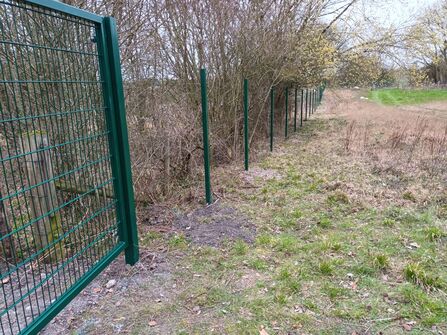
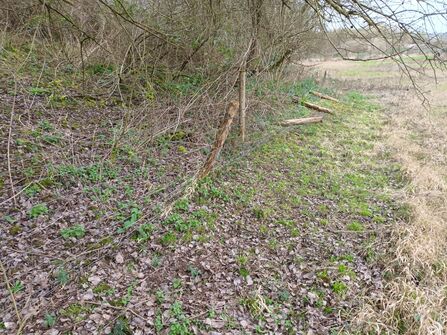
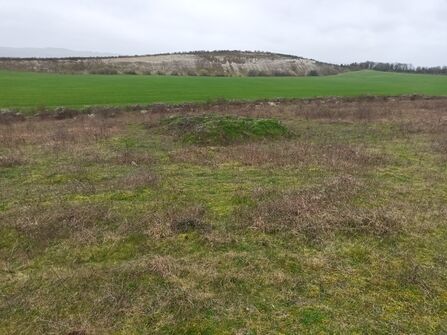
Andy had plans for the afternoon, so I headed over to Totternhoe Quarry to do a site check. There will be a future fencing task in one field, so we need to know how many posts to replace.  Contractors had also been at work putting some protective fencing in, and I checked on how that was progressing as well.  I then headed out to prospective task locations for next week to see what needed to be done, and what was possible given that birds were now starting to nest.  It also gave me the chance to refresh my knowledge of the site as I hadn’t been round most of it since I was a Volunteer Officer nine years ago.  I decided that the scrub was small enough and spread out enough that we were unlikely to disturb nesting birds while working there, and that there was more than enough to do for a Tuesday task, in Spot’s Field on the far eastern side of the site.  This field is intended to be grazed by sheep, but the small scrub is likely to be a nightmare for the sheep as it will constantly catch in their wool, so it’s a good choice for a task.  This field is also the site of some of the Trusts experimental butterfly banks, letter “E” shaped mounds that create microclimates and varied habitats, to encourage certain butterflies to breed there.  Each mound points in a different direction, so we can find out which orientations are the most beneficial to diversity and butterflies.

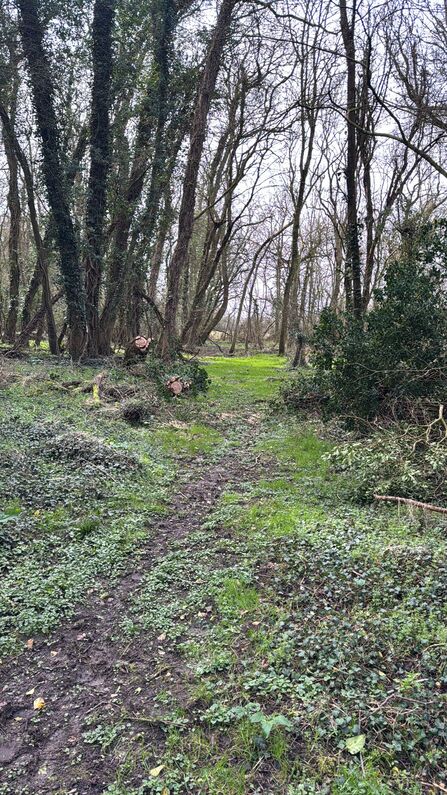
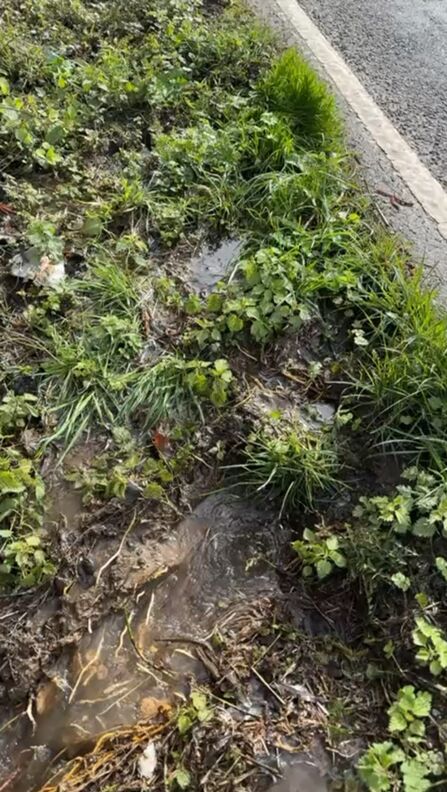
On Friday S.R.O. Rich and I went to deal with the trees at Fancott Wood.  I was so engrossed with the work; I still forgot to take any pics… We cleared five trees that were blocking paths and one that was a bit dangerous, balanced on another tree, and over the footpath.  We struck it lucky with the tree on the bridge.  The tree is from our side, so all the branches and roundels we cut would have to be moved off the neighbouring farmland and back over the bridge. There was a lot of it.  It was quite a big tree.  Just after we finished getting the tree cut up, some lads from the farm came over.  They’d heard the saws and guessed what we were up to.  The end of the tree had blocked a path and landed on their field. The public had detoured round the tree, onto the field.  As we were clearing it up, they decided to give us a hand.  Even better, they told us they’d use the wood as firewood and if we left it on their land, they’d clear it up and take it away for us, saving Rich and I an hour’s work carrying and stacking it all!  Thanks guys!  After we were done, we investigated why the footpath through the wood had recently become so incredibly wet.  It appeared to be something to do with the roadside ditch, but it didn’t make sense because it had never been an issue before.  Good thing we investigated because we found a mains water leak that was flooding the ditch and then into the wood!  I reported it to Anglian Water, who investigated it and should be out to repair it on Monday.  It will be interesting to see just how much of the water in the woodland was due to the leak.  After that Rich and I split up and took care of the never-ending paperwork our jobs create. It also gave me the time to write this article!

As always, thanks to all our volunteers.  We really only accomplish as much as we do due to your Herculean efforts!  

Yours,

             Jamie