Is the Lawn Dying Out?

We asked our community their thoughts - should we still be keeping lawns, or do we favour leaving it all to nature?

With the hottest recorded May - and now June - temperatures this year, and each summer becoming drier, how are our lawns faring? Should we be striving to continue the practise of keeping a short, neat, grass lawn or should we surrender our green carpets to nature and allow the wildlife to take over? Perhaps there is a compromise to be met? In our May E-newsletter we asked our community -  should we be giving up our lawns for the wildlife year round… not just for ‘No Mow May’?

Here are their thoughts:
Let's keep the grass... but make it wildlife friendly!

"I've rehomed my electric lawnmower and got an old fashioned push mower. It cuts the grass longer than the highest setting on my old mower, and I'm beginning to get daisies, buttercups and clover growing. I'm hoping that's just the beginning."

~ Heather L

"I have quite large lawns and since the " no mow may " was introduced I have kept this practice up but I do still mow but not as frequently and leave 5 quite large semi circular clumps of unmowed areas which do attract the swallows and pied wagtails. I have also tried "wildlife corridor tracks" but this didn't seem to work as well.

The lawn seems to be in decent condition as when it has rained I have purposely left it quite a bit longer before I mow again and usually manage to mow it before 10 a m to help it not getting "stressed "."

~ Glyn C

"Anything is better than the gravel or block paving so many of our neighbours have now! 

A few years ago, after a visit to a wildflower meadow owned by a couple of Trust members, I suggested to my wife that we should make our back garden into a wildflower meadow, which would have the triple benefit of not needing mowing (my job until we got a reliable gardener), would be beneficial to wildlife and look so much nicer than the scrappy grass we had.

Unfortunately She Who Must Be Obeyed said ‘no’, so we still have a scrappy lawn to look at, though we do have a fair bit of wildlife as well around the border and trees, just not as much as we could have had.

I guess that climate change, though it does seem to be speeding up, will not change things all that much while I’m here this time round, so it doesn’t really bother me at the moment - except the day-to-day weather that stops me doing many of the things I’d still like to do!"

~ Peter H

"Lawn doing fine, thank you, with no irrigation. Loads of butterflies on the farm too!"

~ Mike K

"No..my lawn is not dying, as I have put it to a wildflower patch,and only mow the edges and a path. It is so much easier to handle too, as it is strimmed in October (all the cuttings removed) mowed 2 weeks later...and that is the maintenance done for the year. 

 I wish more people would do the same,but they seem unable to stop mowing!"

~ Jillie L

"Those of us who can should allow the lawn to go over to native wildflowers, I have followed no mo May for 4 years and its a joy to see what comes up each year, which does vary, this year I am chuffed to bits to have cinnabar caterpillars on my Ragwort. Self Heal is doing very well, much better than last year and I havent even begun to identify all the lovely wild flowers that are popping up on what was previously a block paved front drive desert.

We need to remove the word weed from the dictionary, there are only wild flowers, BRING IT ON.

Also hercicides and pesticides need to be a thing of the past especially in private gardens and public parks."

~ Gillian J

"I adopted a wildlife garden approach a few years ago just leaving a small patch of cut lawn for practicality reasons like access. 

Watching the flora and fauna❤️🐦‍⬛🌻 is excellent for my wellbeing and garden jobs for my exercise. The baby birds at the moment are so entertaining as their parents endlessly feed them🪱 and they all drink from the water feeder. Hedgehogs have right of passage and a house too🦔 Bees and butterflies are abundant on the bug friendly plants or at the insect water "daffodil" bought years ago to support breast cancer💞 
I love visiting the National Open Garden Scheme gardens but most are just too neat  and very maintenance high with there lawns cut within an inch of their lives and the edges too neat! However, it keeps the owners healthy and happy and wildlife is apparent. 

A balance is the answer in my opinion 😀"

~ Sally R


No lawns at all, thank you!

"Many lawns have been poorly designed and prepared. I got rid of my lawns 20 years ago. A nice one looks great but a low maintenance alternative can allow water through to support the aquifer and reduce the awful use of potable water."

~ Eamonn D

"I feel that the lawn is dying out. I don't have one instead I have a pergola which is now covered by ivy, clematis and wisteria giving a home to wildlife and a feeding ground for other. This is surrounded by a path of decorative stones, it is amazing how many different creatures make it their home.  Apart from the occasional weeding it is low maintenance and doesn't need water."

~ Diane C

"I am a member of a U3A gardening club and speak to other gardeners. Some of them, after summers where the lawns were patchy and unattractive, have removed the grass and gravelled the area, whilst leaving areas of planting. If future summers are to be hotter and drier, with restrictions on watering, lawns may become impractical for many.  

Many people in modern houses with smaller gardens, are finding it practical to remove their living grass in favour of artificial turf, which provides a hard wearing and low maintenance surface for children's play. Magazines and influencers are promoting the idea of gardens as 'outside rooms', where wildlife is scarcely given a thought. The emphasis is on seating, fire pits, barbeques and pizza ovens, even sound and film systems

It is interesting that many people who will profess to be interested in the environment, really mean that which they see on TV wildlife programmes, they do not seem to relate this to the immediate environment over which they have control. 

The prevalence of front gardens becoming off road parking spaces, especially where access to electric charging points is necessary, will further hasten the demise of lawns, which will eventually be restricted to larger properties with private driveways."

~ Kate P

How about a lawn alternative?

"3 years ago I started to let the wildflowers take over my front lawn. Straight away I saw how much more resilient the grass was to dry spells now that it was longer. Grasshoppers galore moved in, along with other insects.

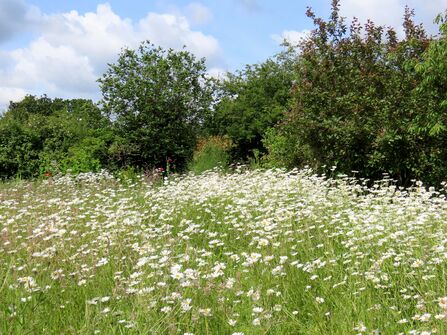
Now the “lawn” is a beautiful array of oxeye daisies and buttercups with a border of crown vetch and harebells. Knapweed is just coming into flower. Just lately one or two people living close by have said they are now leaving their lawns to go wild like mine.

I have far more bees, flies and beetles amongst the flowers but have also noticed that the small birds are foraging amongst my wilderness.

For no real effort it’s a win win all round."

~ Liz H

"I have a camomile lawn.

It thrived in the hot spell, never needs mowing, though I do weed it, to reduce the competition."

~ Anne S

There's a compromise to be met...

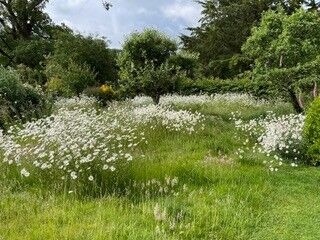
"Have both. I have one small lawn which I mow, but not the corners where there are cowslips. I mow the corners when the seed has set. I leave a large clump of marjoram in another corner but mow before winter. Another lawn had clumps of oxeye daisies and a few cowslips and lady's bedstraw. the oxeye daisies have moved to the rest of the lawn, the cowslips are everywhere so I just do not mow this lawn until late summer. I leave it for people walking down the lane to enjoy."

~ Rosalind W

"We do not regard the grass that grows to the front and back of our house as lawns, as such. The grass tends to grow short where we walk most frequently, and apart from one tuft, I have not cut the grass at all this year. We enjoy watching the bees and insects investigating the flowers. Flowers have been infiltrating the grass areas from the borders since last year, so any grass cutting has to be selective and only with hand shears. Our grassy areas are green and lush.

I hate seeing the damage that is done to the grass verges when the councils set the sit-on mowers loose."

~ Lesley R

"Lawns look neat when cut short and neat but they are not so interesting. If a lawn has wild flowers and longer grasses (particularly when they have seed heads), they are much prettier and bees/butterflies/birds/other insects visit and the lawn comes alive, it is busy with activity.

If people don't want to give up their lawn entirely they could have part wild and part cut short or a cut path wnding it's way through the wildflower 'meadow'.

Maybe if they do a part they may decide to leave more to be wild.

However, people would need advice on how to start a wild lawn and also information on how to maintain it. 

We are going to have a wild 'lawn' and encourage stll more wild flowers into it. at the moment we allow our lawn to grow longer and we do not remove any wild flowers that appear."

~ Anonymous

"I do not believe "one size fits all". There are good reasons for having both long and short grass: during wet spells our lawns are used massively by blackbirds as they go worming; likewise long grass is good for insects. So ideally we would all have both in our gardens. However, much depends on location and surroundings: a lawn that gets baked to a crisp and spends most of the summer brown is both useless and ugly, so that leaving it to get long and encouraging wildflowers would be more sustainable and attractive. However it is worth remembering that most people do not use a scythe! So later cutting could be  a problem for many. However, a shady spot, or in an area that gets lots of rainfall, is fine for a clipped lawn, and shows off gardeners' hard work on borders and beds. I think that leaving grass long where possible and appropriate should be encouraged, and alternatives to grass considered too (NOT paving or gravel!), for example herb lawns, or pathways through dense planting of flowering plants. The key is to provide habitat for wildlife."

~ Andrea S

"We got rid of our front lawn years ago , raising the flower beds with the turf and covering with porous membrane then gravel .

It now a super area for seedlings, wind blown , bird dropped and from my neighbour’s garden . All sorts of plants start their life in the gravel and from there we transfer them into the flowers beds .

The back garden has evolved over the years from mostly lawn to some lawn with mixed beds and a medium size pond .

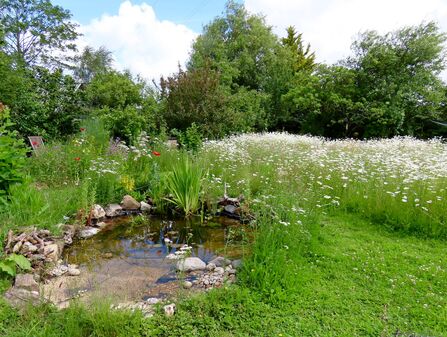
Now our family are older we have invested in letting nature do its thing at the top of the lawn . Under the plum tree the this year it’s full of oxe eye daises with additions of yellow rattle , wild carrot, tansy, vetches , burnet , ox tongue , all added from seed . Quite a mini meadow!

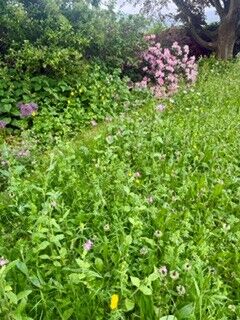
We’ve cut the grass in stages and this year only clipped for access to the shed ,washing line and compost bins so leaving a short but lush level of clover daisy with buttercup , dandelions, speedwell and self heal.

This is not a complete list as many other plants have appeared along the way . Some of these into the main beds adding colour and variety to the mix.

This year we have loads of red campion which only first appeared a few years ago.

Such is the joy of watching nature take over!"

~ Tina A

"I'm not fortunate enough to have a garden, but if I did it would be wild. 

Perhaps not completely wild - it would be managed so that certain more aggressive plants didn't completely take over. I'd also have some planted areas with lavender and plants beloved of bees and other insects.

I might keep a small section of grass for sitting on, but it wouldn't be cut short and it wouldn't ever be "treated" with weedkiller - dandelions, daisies, clover, burdock etc. would be encouraged. I don't think that a large square of lawn being the dominant feature of a garden is a good thing. It deprives invertebrates of a habitat, which in turn is bad for hedgehogs and other animals that feed on them. It's bad for biodiversity. It's boring!

I love the cultivated wilderness around Whipsnade Zoo. As well as the zoo animals, a lot of indigenous animals roam around, along with the wallabies and mara. Last time I was there, I saw a red kite swoop in an attempt to catch its prey. We need more natural environments and people's gardens make up a lot of the undeveloped land in the UK.

I hope the ideal of a manicured, water guzzling lawn dies out and that people grow to appreciate a more natural garden."

~ Maria S

"I think short grass has its place for dogs and kids to run around on, otherwise ditching the sprays and fertilisers and creating meadow habitat is fantastic for wildlife and biodiversity. We need to shift our mindset from liking ‘tidy’ to liking ‘buzzing’. As we expand our urban areas and destroy more countryside, we need to support nature by being as wildlife-friendly as possible. 

Meadows can be made to look smarter and more purposeful by mowing a strip around the edge.
Our front and back lawns are now full of diversity and we receive many positive comments, including how to do it. We think it is a lot less work than mowing every week and much more rewarding!"

~ Rebecca & Paul B

Gardening

Wildlife Gardening Award Scheme

Have you got a wildlife friendly garden? Enter our award scheme and recieve a plaque!

Learn more
WAG23_Website_Banner

Gardening for Wildlife

Tips and advice on making your garden more wildlife friendly.

Learn more